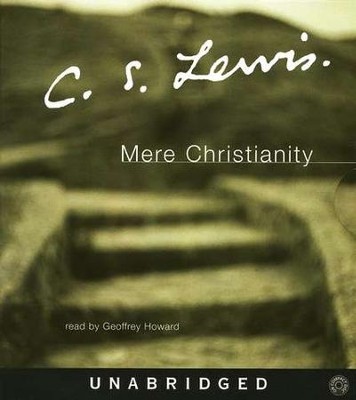
Welcome to the Mere Christianity
read-along. I'll be covering one-two chapters each post, approximately one to two times a week. This week we'll be covering the Preface and discussing the context of the book. In addition to the book, I may occasionally reference The Great Courses: Life and Writings of C.S. Lewis
by Professor Louis Markos.

Preface and Background
Mere Christianity is a bit of a different book. It's heady and theological (don't come into it expecting it to read like
The Chronicles of Narnia), but it also has a curiously familiar and conversational quality to it. No doubt this is partly due to the fact that is adapted from C.S. Lewis' audio talks over the BBC radio from 1941-1944, during the height of WWII. The result is a conversational book that tackles tough topics in an understandable way. The times also show through in the book; references to military action and analogies to war are quite common and likely would have struck a chord with listeners (and later, readers).
In the preface, Lewis starts out with a somewhat long summary of how he decided to edit the book--it's obvious he put an extraordinary amount of thought into it, even obsessing over contractions--but he then gives way to a much more intriguing discussion on his reasoning behind the book. He has set out to explain Christianity in its most basic form--something that anyone who calls himself a Christian can agree on. He explains that he has deliberately tried to avoid controversial issues and leave those to the reader to understand. I find it particularly encouraging that he sent the most heavy theological portion of the book to members of other denominations to be reviewed (Lewis himself was an Anglican).
He ends with a fantastic opinion on denominations, which you can find in the discussions below. I have frequently referenced the analogy in discussion with friends and it has helped a couple understand my position (a firm member of a denomination who believes its doctrines are true and correct while also understanding that others must be fully convinced of their own convictions).
Discussion One
Lewis writes: "It is not for us to say who, in the deepest sense, is or is not close to the spirit of Christ. We do not see into men's hearts. We cannot judge, and are indeed forbidden to judge. It would be wicked arrogance for us to say that any man is, or is not, a Christian in this refined sense...We must therefore stick to the original, obvious meaning. The name
Christians was first given at Antioch (Acts 11:26) to 'the disciples', to those who accepted the teaching of the apostles...When a man who accepts the Christian doctrine lives unworthily of it, it is much clearer to say he is a bad Christian than to say he is not a Christian."
How does judging a person's salvation differ from judging their actions? When is it acceptable to judge someone's actions if they're a Christian? What if they're not a Christian? How do you address these situations if they think they need to be addressed?
Discussion Two
Lewis writes on denominations: "It (basic or mere Christianity) is more like a hall out of which doors open into several rooms...The hall is a place to wait in, a place from which to try the various doors, not a place to live in...above all, you must be asking which door is the true one; not which pleases you best by its paint and panelling. In plain language, the question should never be: 'Do I like that kind of service?' but 'Are these doctrines true: Is holiness here? Does my conscience move me towards this? Is my reluctance to knock at this door due to my pride, or my mere taste, or my personal dislike of this particular door-keeper?'...When you have reached your own room, be kind to those who have chosen different doors and to those who are still in the hall."
What role should denominations play in Christianity? Is there a good reason for them? How should we address differences in the church? How did you choose your personal denomination? Is being non-denominational its own kind of organization, statement, or theology? If Christianity doesn't have denominational organization, how should it be organized?

 As an aside: If you, by chance, are moving and happen to be without internet for a few weeks and have posts planned to auto-post, it pays to double-check that they will actually post themselves for you, rather than leaving your readers hanging for a better part of the month. Sorry for the gap, folks! Regular posting will resume Friday.