Friday, October 19, 2018

Reflections: Work

Some foolish person somewhere once said, "Choose something you love and you'll never have to work a day in your life."

I don't know where they were working, but I find that a little too good to be true.

You see, when I'm not writing, I'm doing my "real" job as a veterinary technician. And I love it. There's nowhere else I'd rather work, no other team of coworkers I'd rather have, no other job I'd rather do.  It's challenging, rewarding, heartwarming, fun, enjoyable, and (though it sounds terribly cliche) my passion. I can't imagine doing anything else full time, even writing.

But it's work. To steal a quote from the Princess Bride, "Anyone who says differently is selling something."

Even on this week dedicated to  my profession
, where my awesome workplace insists on showering all of us techs with food and coffee and gifts, it's work.

Holding down a Mastiff that's dysphoric and unsure where it's at when it's waking up from anesthesia is work. Pulling up a downed horse using ropes is work. Scooping manure is work. Dragging yourself from your warm bed at 2 AM to go anesthetize a cat that ate a thread is work.

It's not glorious. It's sweaty. Hot. Sometimes miserable. Heartbreaking, when all your effort goes to waste.

You see, we seem to think that work is a bad thing. That putting forth effort, that striving with all our might, that throwing our backs into the ropes, is the worst thing that could happen. That trying to learn the names of 30 different drugs and how they work is torture. Work. It's an ugly word.

But is work really a bad thing? What if we rephrased "work"? What if we chose "strive" instead? Working isn't bad. Drudgery is bad. Working only for the money is rather dismal (and I suspect that's what the author was truly driving toward). Don't get me wrong--you should do something you enjoy, something you're good at, something that gives you purpose. 

But would our goals really give us purpose if we didn't have to strive for them? Give them everything we have? Would our jobs be as rewarding if they came easily to us?

That's the true drudgery we ought to avoid.

So, rather than avoiding work, let's find work that really satisfies. A job to which we can apply our efforts with our whole hearts--whether that's writing or something else entirely.

 Go find something worth putting your soul into, even on days when it feels like really dull work.

Friday, October 12, 2018

NaNo 2018 Intro

I can't believe it's been a year since I've written anything in a WIP. I've...missed it. But I must confess, I fear sitting at my computer November 1st about to engage in the insanity that is NaNoWriMo and finding that my entire ability to write has disappeared.


That being said, I've found that doing things that I fear (because of the possibility of failure) are some of the most rewarding things I've ever done. And also the craziest, but, you know...

Will I write 50k? I don't know. That's a lot. And the years I really set out with 50k in mind tend to be the years I faceplant. Instead, I think I'm going to take my 2016 approach--the last time I won. I'm going to set out to write at least 6 days a week and shoot for a wordcount of 20k. It doesn't have to be a cohesive novel. I'm not going to plan it out. I have a main character, and a concept, and that's about it. We'll see what happens.

How will posting work on the blog? I'm really happy to have posted 3 weeks in a row now. (Wow, my life is getting sad. But we're improving.) I hope to keep it up. I'm thinking I might try some story snippets this year. My story idea is a little disjointed, which might make it good for some snippets.

Anyways, NaNo is about having fun. And if it keeps me busy and gives me a bit to think about other than work, I'll take it.

Even if my novel is essentially about anesthetizing mythical creatures. Because I have no life.

Are you participating in NaNo? What's your story about?

Friday, October 5, 2018

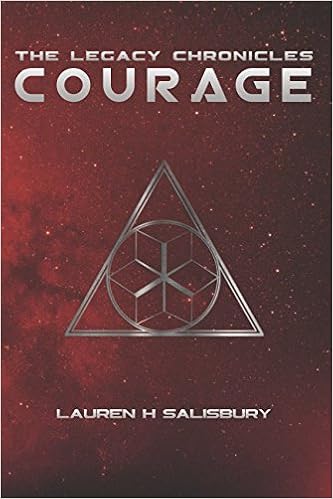
Friday Fiction Fix: Courage

The Short

Courage
Book 1 of The Legacy Chronicles

By: Lauren H. Salisbury

4.5/5 Stars 

What: A slave woman must evade an alien empire to save her son's life.

Recommended to those who like: Sci-fi, Christian, allegory

The Long

*I received a free copy of this book in exchange for a fair and honest review*

It's been a horribly long time since we had a book review on The Book Hound, but I can think of no better book to come back on. Courage is the sort of book that the blog was designed for--imaginative Christian speculative fiction that's written to excellent standards and provokes deep thought in the reader. (Also, I'd like to give a shout-out to Ms. Salisbury for being patient with me for the overly long time it took me to review her book. She's a saint.)

In the future, humans have been enslaved by the powerful Esarelian Empire. In spite of their daily hardships, many of them maintain hope and faith in the God from Old Earth. One such couple is Elias--a man who will fight to the end for his family and their community--and Gilla--who wishes to pass on her strong faith to her children. But before their next child can be born, their world is turned upside down and Gilla must have the courage and faith to protect her son.

The resulting story is imaginative, colorful, and rich with life. Once I finally sat down to read it, I flew through the (digital) pages. While insightful readers will discern quickly what Biblical story the novel parallels, the characters feel like truly living beings with their own motivations, emotions, and thoughts. While the allegorical nature of the plot makes some points predictable, the setting gives the story fresh life and insight.

The story does at points rely on strong telling rather than showing, but I found that the writing overall was of good quality and added to the story. 

The Bottom Line: A great pick for readers who enjoy sci-fi with an allegorical twist, I would recommend Courage to readers who are looking for a relatively quick and enjoyable read with rich characters and intriguing settings.

Friday, September 28, 2018

The 2018 Tolkien Tag

It's Tolkien Week again! To celebrate, I'll be filling out the blog tag from Hamlette over at Edge of the Precipice. (And don't run too far--I've actually got a book review lined up for next Friday!)


1.  What's your favorite Middle-earth story/book?
This one depends entirely on my mood. Ready for something lighthearted? The Hobbit. On a drive or somewhere where I need to gnaw on something for a few hours? The Silmarillion. Feeling dark and upset at the world? The children of Hurin. 

In short, there's a Tolkien for just about every one of my moods.


2.  Do you have a favorite subplot?
I don't know if it counts as a subplot or a book since it came out as its own story, but Of Beren and Luthien out of The Silmarillion is definitely my favorite.
3.  What's your favorite theme in Tolkien's books?  (Can be in one specific story, or overall.)

I really like the idea that history is made up of individual people who do great things (or even seemingly simple things that end up being monumental). It gives me hope for  doing the little things in life.


4.  Do you have a favorite weapon from Middle-earth?
Probably Anduril--it's hard to beat its history. I really wish there were more named bows from Middle-earth, however. 


5.  Would you like to be a hobbit?
Let's see, I like to eat, farming doesn't sound too bad, I'm happy to have a simple life, and I don't mind going barefoot, so...sure!

6.  Do you have a favorite romance/couple?
That's a nearly impossible pick between Beren and Luthien or Faramir and Eowyn. I don't like romance as a general rule, but Tolkien writes dang good romance. 

7.  What's your favorite Middle-earth creature?  (Can be "real" or "imaginary.")
Oliphants! Mostly because Samwise likes them so much.

8.  What character do you look the most like?
Ooh, I don't know that I look much like any character since I cut my hair. We'll go with some hobbit--my love of food shows a little bit.

9.  Are there any books about Middle-earth or Professor Tolkien (but not written by him) you recommend?
I have not actually read any books about either the author or the place, unless you count the works edited by Christopher Tolkien. It's a deficit that I'll have to make up sometime.

10.  List up to ten of your favorite lines/quotations from the Middle-earth books and/or movies.
Alrighty, here we go again! As always, I've tried to avoid duplicating my answers from previous years:

-"What do you mean?" he said. "Do you wish me a good morning, or mean that it is a good morning whether I want it or not; or that you feel good this morning; or that it is a morning to be good on?" (Gandalf)

-"In one thing you have not changed, dear friend," said Aragorn: "you still speak in riddles."
"What? In riddles?" said Gandalf. "No! For I was talking aloud to myself. A habit of the old: they choose the wisest person present to speak to; the long explanations needed by the young are wearying." 


-"Begone, foul dwimmerlaik, lord of carrion! Leave the dead in peace!" (Eowyn as Dernhelm)

-"Fool of a Took!" he growled. "This is a serious journey, not a hobbit walking-party. Throw yourself in next time, and then you will be no further nuisance." (Gandalf)

-"What course am I to take?"/ "Towards danger; but not too rashly, nor too straight." 

I hope you enjoyed my answers. Be sure to check out the rest of the festivities going on over at The Edge of the Precipice this week and be sure to stop back in here next week for a sci-fi book review!

Friday, August 17, 2018

Reflections: It Doesn't Get Easier

One of the activities that took part of my time away from writing this spring was training for my first half marathon.

Don't ask me what I was thinking when I signed up for it. I was always the kid in gym class who hated running, and while I've run a 5k most summers for the past few years, I've never called myself a runner. I'm someone who runs, not a runner. (There's a difference. Or at least there was before I hit double digit mileage).

A friend and I decided to sign up to celebrate her college graduation and so I found myself freezing in a picnic shelter on a 15 degree morning in January with about 100 random strangers who were all smiling and getting ready to run. They had a bunch of hi-tech gear and didn't seemed bothered by the cold. There was a guy training for the Boston Marathon, a few retirees who looked like they could kick my butt in just about any sport, and an entire other assortment of strangers who looked like they were born to eat up the mileage.

Meanwhile, I was thinking of my warm car, the fact I had skipped my coffee that morning, and trying not to compare my gear with everyone else's. It consisted of a pair of off-brand sneakers from a local supermarket, discount workout pants that I hadn't tested yet, two old sweatshirts, a homemade wool hat, and a ten year old bargain brand fleece jacket. I was still freezing in spite of the sweat percolating underneath all the layers.

The terror of being there was real. By nature, I'm an introvert--and by introvert, I mean, "can go three days without seeing people and be perfectly fine" and "would rather exile myself to a desert island than have to go to social events".

I found a pace group that I thought I would fit in with (it was the second slowest running group, so it was mostly retirees who were talking about how many marathons they were going to do that year) and tried to smile.

The groups started leaving and I began to trundle down the icy, snow covered park path with the other crazy people. In spite of having been trying to get in shape for the previous couple of months, the cold air felt like it was knifing my lungs and the pace group was a push for me. I spent the last 2.5 miles of my 3 mile run chanting to myself, "Warm shower, hot coffee. Warm shower, hot coffee..."  At the end, I collapsed in my car, turned the heat on full blast, and tried to warm up from my sweat-soaked bargain clothes.

And I had to train to run 10.1 more miles.

It seemed impossible, but I figured I wouldn't judge the effort off of the first run I did. It would get easier, right?

A few months later, each run was still hard. The darn things just kept getting longer! Now I was running 5 miles two evenings a week over still-icy pathways and my weekend mileage was climbing. The first day it was warm, it rained so hard that water was running off my elbows and I had to slog through puddles that came up to my ankles. In spite of the 60 degree temperatures, I was colder than that first run. The next week, I face planted in the middle of a street and bruised my knee so I couldn't run for a week (which really sucked because the weather was finally nice).

Then came the moment I had secretly feared: my longest run to date. When you've only ever run 6 miles, 8 is terrifying. And due to traveling on the weekend, I opted to run it alone. I plugged in my earbuds and tried my best to jam out as I ran through campus--deserted,since all the students were on break. Used to the cold, I had dressed too warmly and I was panting for the last 3 miles, trying to tough it out. I was rewarded by the feeling of euphoric runner's high and I let out a shout of victory when I got back to the car. My knee buckled out from under me and I still grinned. It had finally gotten easier! I was finally enjoying running! I mean, sure, the cotton-dry mouth had sucked, but I had gotten a runner's high. 7 miles in I had belted out the words to "Walking on the Sun" as I came down the home stretch. It was great! I was going to do this!

I stretched out, then climbed in the car. At first, I thought it was just the runner's high wearing off, but the fuzzy feeling in my head could only mean one thing: my blood sugar had bottomed out. Even though it was only a ten mile drive home, I felt terrible and had to fight just to stay focused on the road. I rushed in the house, feeling nauseated and light-headed, hoping I didn't pass out before I could get some sugar in me.

I was out of juice (my go-to pick me up) so I resorted to eating sugar cubes. The fuzzy feeling abated and my ears slowly stopped buzzing and my hands stopped shaking.

And then disaster struck. I ran to the bathroom and vomited up all the sugar cubes I had just eaten.

10 minutes later, my sugar crashed again.

Cue more sugar cubes.

Barfing.

Repeat for two hours.

But wasn't it supposed to get easier? Wasn't running supposed to be easier now than on that first cold morning? Why was it still so hard, even when I just did 2 mile "recovery" runs? (And who decided, "Hey, you know what people training for a half marathon want the day after running insane mileage? More running! Yeah, that's a great idea!" 'Cause I officially don't like that person.)

I seriously doubted my ability to run the race after that night and, if I hadn't been running it with a friend, I'm sure I would have backed out after that night.

The next few runs I went on, I was scared and dispirited. I didn't want every run over 6 miles to feel so miserable--after all, I had a lot of them left. That's when someone mentioned in passing, "You know, it doesn't get easier--you get stronger."

That thought changed my whole training mentality and I'm trying to let it seep into the rest of my life, too.

No matter how bad or good of shape you're in, it still takes effort to run 5 miles. What changes is that you become stronger to get there. The run, the circumstances, don't get any easier. They don't change; you do.

You can draw on all those scraped knees, missed quiz questions, and bad days to become stronger. It won't make it easier when your car breaks down twice within a week of moving while work is a disaster. Rather, you'll be strong enough to handle it (even if there is a little maniacal laughter along the way). And, if you aren't strong enough to handle it, God's still there for you.

Long story short (we'll omit a few more scraped knees and one black toenail), I finished my half marathon with a pained smile on my face and doubled over two steps after the finish line, exhausted, but stronger than I was back in January. And yes, half of my equipment was still from the supermarket, if you're wondering.

Sunday, August 12, 2018

Mere Christianity: The Reality of the Law

As an aside: If you, by chance, are moving and happen to be without internet for a few weeks and have posts planned to auto-post, it pays to double-check that they will actually post themselves for you, rather than leaving your readers hanging for a better part of the month. Sorry for the gap, folks! Regular posting will resume Friday.

In this chapter, Lewis returns to his argument that humans, though they know how they ought to behave, behave differently, which is different than the other laws of nature (such as gravitation). Furthermore, he puts forward the notion that these differences are born not of necessity or personal convenience. For example, "I am not angry...with a man who trips me up by accident; I am angry with a man who tries to trip me up even if he does not succeed." Why should one be different than the other? Lewis points back to the natural law, or Law of Human Behavior as the rule by which we judge the world.

Discussion:

Lewis states: "...the behavior we call bad or unfair is not exactly the same as the behaviour we find inconvenient and may even be the opposite." How do you argue that we should do things that are not always convenient and may even be hurtful in the moment (such as telling the truth)? Do you ever find this hard to do?

Friday, July 13, 2018

Mere Christianity: The Law of Human Nature and Some Objections

Summary


These are the first chapters that truly get into the meat of the book. In chapter 1 (The Law of Human Nature), Lewis argues for the existence of God by stating that we all, when in an argument, appeal to a law greater than ourselves, whether we are conscious of it or not. We appeal to fairness, or, in a greater sense, right over wrong. While we might argue, for instance, that we can cut in line because we have more pressing matters than the person we cut in front of, it is a rare person who argues that the rules of not cutting in line don't matter. 

Lewis argues that this instinct or urge must come from somewhere and that it is similar across all cultures. (He supposedly delves into this more in The Abolition of Man, which I haven't gotten around to reading yet; it sounds like an interesting read). Lewis further points out that, unlike other natural laws (such as gravity), this law of morality is not universally followed, though it is universally acknowledged. We might appeal to fairness, but we try to find ways to get out of being fair when it benefits us. Rather than saying that fairness doesn't matter, we still try to uphold it, even though we know we're going to fail. It's a rather peculiar thing that I'd never thought about much.

 In the second chapter (Some Objections), Lewis addresses some well-thought counterarguments to his position. First, he points out that one might argue that this law of morality is merely a herd instinct. However, what happens when morality comes into conflict with another instinct (such as the need for food)? How does one instinct win out over the other? Mustn't there be a third inclination (the moral law) that judges between the two which is appropriate? Otherwise, why would people rush to someone's aid who is calling for help (or at least feel they ought to go help, even if they don't)?

The other counterargument he addresses is that the law of morality is merely a taught convention. He firstly points out the similarities between moral standards across cultures as compared to other standards (such as dress or which side of the road is appropriate to drive on). Then he argues that, even if morality is taught, it is more akin to mathematics than anything else. Truth about the moral law can be discovered and implemented, judged against one's internal conscience. If you say that many moralities are better than that which the Nazis held, what standard do you judge it against? Your own? Do you merely prefer it, or do you truly think it right? Most people would say they are convinced of their own morality mirroring a true morality--again, a comparison to a "gold" or true standard.

Discussion

Where do you think conscience comes from? What role does it play in our walk with God and does it change if we are Christians? If so, how?